The Issue of Light and Water – And Petar Senjanović’s Other Open Questions
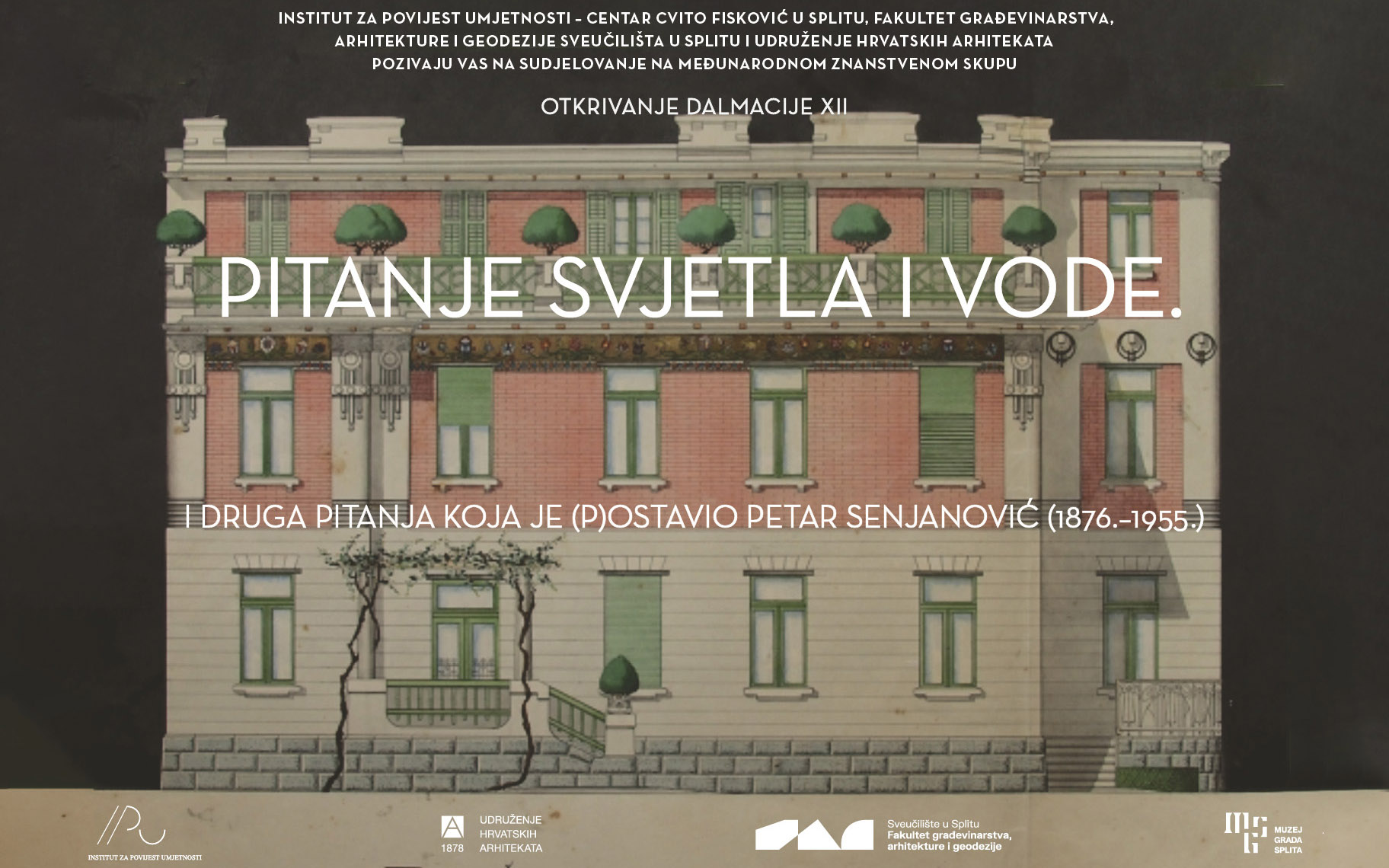
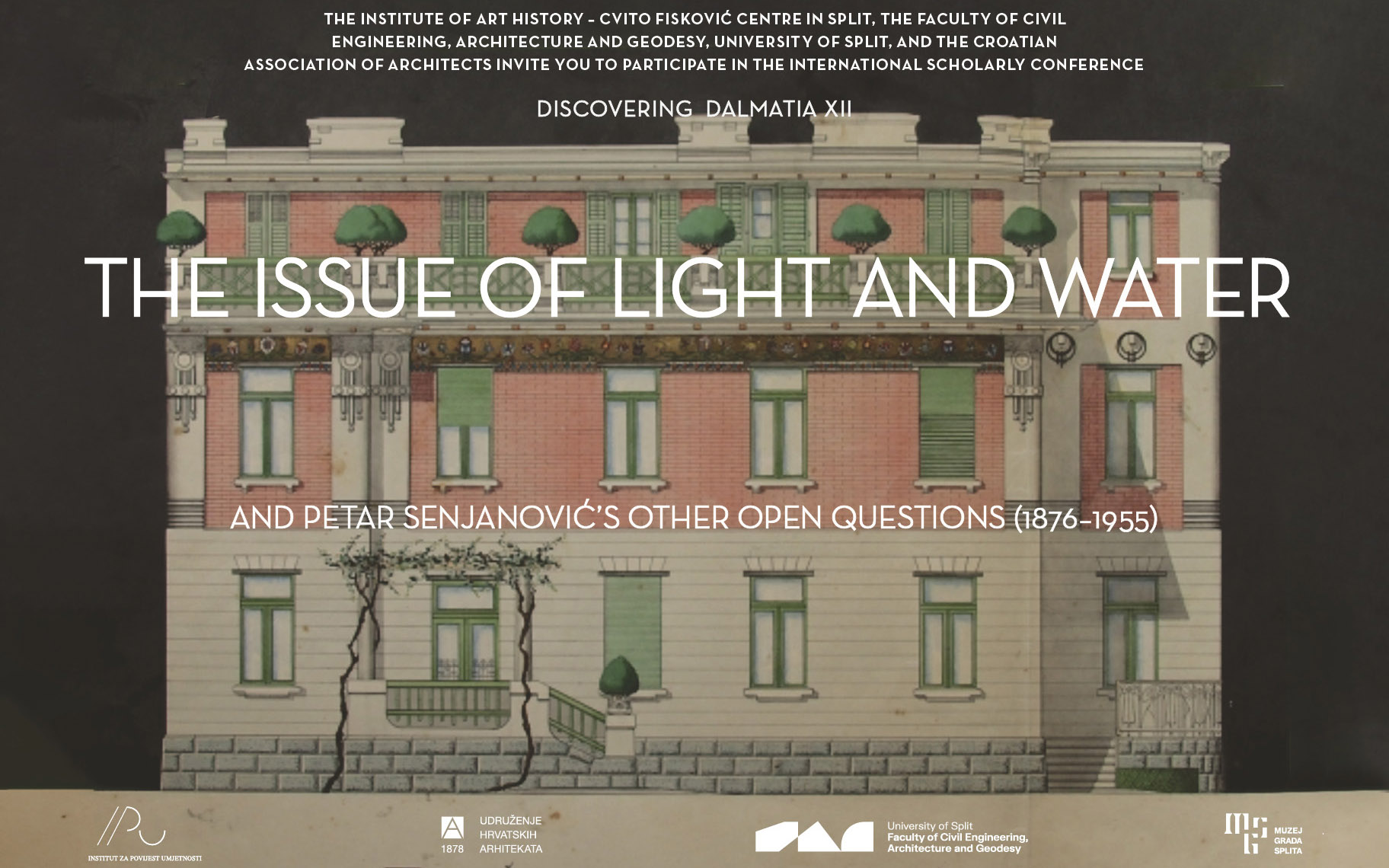
The Institute of Art History – Cvito Fisković Centre in Split, the Faculty of Civil Engineering, Architecture and Geodesy, University of Split, and the Croatian Association of Architects invite you to participate in the international scholarly conference
DISCOVERING DALMATIA XII
The Issue of Light and Water – And Petar Senjanović’s Other Open Questions
The Split City Museum, Split, 23–25 November 2026
Marking the 150th anniversary of the birth of Petar Senjanović (1876–1955), this international scholarly conference is dedicated to a fresh examination of his work in the context of architecture, urbanism, and infrastructure development in Croatia and the broader Central European region.
The conference title is drawn from Senjanović’s paper The Question of Light and Water (1910), which on a symbolic level poses a series of fundamental questions about the relationship between the technical, spatial-planning, and social dimensions of city-building. These very questions – of light, water, infrastructure, housing, regulation, and the relationship with the landscape – form the backbone of the conference, which seeks to examine Senjanović’s work in its full complexity.
Senjanović’s activities ranged from architectural interventions in space to urban planning, railway engineering, and infrastructure projects. He worked in a variety of contexts, from Dalmatia and Split to Zagreb and the broader territory of the former Habsburg Monarchy, contributing to the shaping of space at various scales, from individual buildings to urban planning and infrastructure networks. Building on this body of work, the conference moves beyond a focus on a single author to address broader processes and strategies of urban modernization in the early 20th century, particularly in cities on the imperial periphery.
The conference aims to bring together researchers from a range of disciplines – art history, architecture, urbanism, history, and the history of technology and infrastructure, as well as archivists – in order to reconsider Senjanović’s work through contemporary methodological approaches and within a broader comparative framework.
We also welcome submissions from students whose work falls within the thematic scope outlined below.
Key Questions
- How do we understand Senjanović’s practice at the intersection of engineering, architecture, and urbanism?
- In what ways do questions of infrastructure, light, and water shape the development of the modern city?
- How do different scales – building, neighbourhood, city, territory – structure Senjanović’s work?
- How might Senjanović be situated within a broader European context?
- How should we approach the archival materials related to Senjanović, and what methodological and organisational challenges do they present?
Thematic Sections
1. Infrastructure and Territory: Railways, Ports, Networks
- Railway projects (the Lika line, the Una line, and others)
- The relationship between infrastructure and urban development
- Split, Zagreb, and the broader territorial context
- Engineering as the foundation for thinking about urban planning
2. The City and Regulation
- Regulatory plans and urban strategies
- Competitions and participation in professional bodies (juries, commissions)
- Port development and its integration into the city
- The relationship between planning and realisation
3. Housing and Architecture
- Residential construction and contributions to housing typology
- Building regulations and their transformation
- The relationship between tradition and modernity
- Local variants of the Secession style and dialogue with space
4. Landscape Urbanism
- The shaping of Marjan as a public space
- The relationship between nature and a designed landscape
- Recreation, identity, and public space
- Landscape urbanism in a European context
5. Senjanović in Context
- Education and professional networks
- Comparisons with contemporaries (e.g., Jože Plečnik, Kamilo Tončić)
- Central European and Mediterranean contexts
- Knowledge transfer and professional mobility
6. Archives, Sources, and Methodology
- The Petar Senjanović archive and related collections
- The state, availability, and organisation of archival materials
- Unexplored and understudied materials
- Methodological approaches to archival work (cartography, visual sources, technical documentation)
- Possibilities for digitisation and new forms of presenting archival materials
The conference will also include a companion programme – thematic walks and archival visits – devoted to key sites associated with Senjanović’s work in Split.
The conference is organized as part of the UrbArH project of the Institute of Art History, funded by the European Union – NextGenerationEU.
Submissions
Abstracts (up to 250 words), accompanied by a short biographical note, should be submitted in Croatian or English in PDF format to: discoveringdalmatia@gmail.com
Submission deadline: 1 July 2026
Scientific Committee
Hrvoje Bartulović (Faculty of Civil Engineering, Architecture and Geodesy, University of Split)
Joško Belamarić (Institute of Art History – Cvito Fisković Centre Split)
Ana Grgić (Faculty of Civil Engineering, Architecture and Geodesy, University of Split)
Aida Idrizbegović-Zgonić (Faculty of Architecture, University of Sarajevo)
Renata Novak Klemenčič (Faculty of Arts of the University of Ljubljana)
Mihaela Kovačić (University of Split Library)
Sanja Matijević Barčot (Faculty of Civil Engineering, Architecture and Geodesy, University of Split)
Robert Plejić (Faculty of Civil Engineering, Architecture and Geodesy, University of Split)
Karin Šerman (Faculty of Architecture, University of Zagreb / Croatian Association of Architects)
Ana Šverko (Institute of Art History – Cvito Fisković Centre Split / Faculty of Civil Engineering, Architecture and Geodesy, University of Split / Croatian Association of Architects)
Darovan Tušek (Faculty of Civil Engineering, Architecture and Geodesy, University of Split)
Petra Vugrinec (Klovićevi Dvori Gallery)
Organizing Committee
Tomislav Bosnić (Institute of Art History – Cvito Fisković Centre Split)
Ana Ćurić (Institute of Art History)
Ana Grgić (Faculty of Civil Engineering, Architecture and Geodesy, University of Split)
Jana Horvat (Faculty of Architecture, University of Zagreb / Croatian Association of Architects)
Mihaela Kovačić (University of Split Library)
Matko Matija Marušić (Institute of Art History)
Sanja Matijević Barčot (Faculty of Civil Engineering, Architecture and Geodesy, University of Split)
Petar Strunje (Institute of Art History – Cvito Fisković Centre Split)
Karin Šerman (Faculty of Architecture, University of Zagreb / Croatian Association of Architects)
Ana Šverko (Institute of Art History – Cvito Fisković Centre Split / Faculty of Civil Engineering, Architecture and Geodesy, University of Split / Croatian Association of Architects)
Anamaria Veštić (Institute of Art History – Cvito Fisković Centre Split)
Key Dates
- Submission deadline: 1 July 2026
- Notification of acceptance: 15 July 2026
- Conference dates: 23–25 November 2026
Practical Information
The organisers will host a reception on the evening of 22 November and a closing event on 25 November; coffee and refreshments will be provided during breaks.
There is no conference fee.
The organisers are unable to cover travel or accommodation costs. However, the organisers can assist participants with finding reasonably-priced accommodation in the historical city centre.
The official languages of the conference are Croatian and English.
Presentations should be 20 minutes in length.
Papers will be organised into thematic sessions; each session will conclude with a discussion.
Selected papers will be considered for publication in a peer-reviewed volume.
#URBARH